Adding relaxing music to a meditation app without a license may seem like a small risk, especially when the music only plays under a guided meditation.
However, once you publish the app, distribute the recordings, or charge users for access, you are using that music as part of a commercial product.

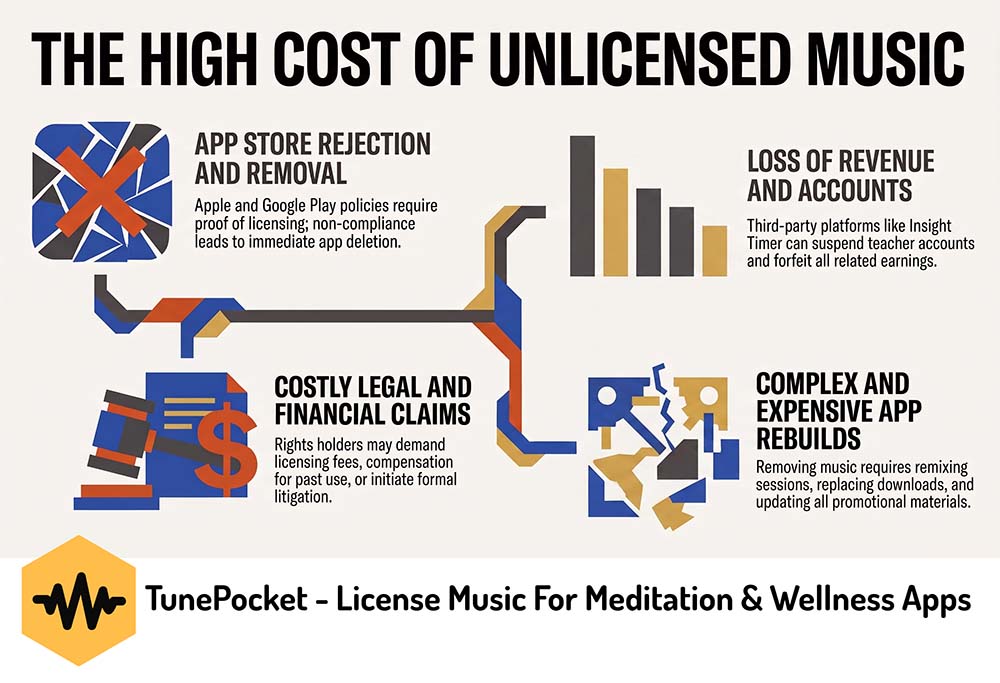
Your app could be rejected or removed
Both major app marketplaces require developers to respect copyright.
The Apple App Review Guidelines state that apps should contain only content created by the developer or content the developer has permission to use.
Similarly, the Google Play intellectual property policy prohibits apps that infringe copyright and notes that developers may be asked to provide evidence of their rights.
Without a clear music license, your app could be rejected during review or removed after receiving a complaint.
Your meditation recordings could disappear
Copyright rules also apply when you distribute meditation content through third-party wellness platforms.
For example, the Insight Timer guidelines for teachers require publishers to have permission to use copyrighted material.
Its integrity and conduct policy also explains that infringing content may be removed, teacher accounts may be suspended, and related earnings may be forfeited.
You could receive a copyright complaint
A music owner may ask you to remove the recordings, pay licensing fees, compensate them for previous use, or respond through a lawyer.
Even when a complaint does not become a lawsuit, dealing with it can require emergency app updates, legal advice, and time spent proving where the music came from.
In one Google Play developer discussion, a developer reported that an app was removed three times following the same copyright complaint while the claim was being disputed.
This demonstrates how disruptive a complaint can become when ownership and licensing documentation are unclear.
You may need to rebuild part of the app
Removing unlicensed music is not always as simple as deleting one audio file.
You may need to remix guided sessions, replace downloadable recordings, update promotional videos, submit a new app version, and explain missing content to paying subscribers.
If the music appears throughout dozens of meditation or sleep sessions, replacing it could become a significant production expense.
The legal risk is real
Peloton offers a prominent example from a related app-based wellness industry.
Music publishers sued the fitness platform over alleged unlicensed uses of songs in its classes. The dispute was later resolved through a settlement between Peloton and 14 members of the National Music Publishers’ Association, according to the official NMPA and Peloton announcement.
A small meditation app is unlikely to face a dispute on the same scale, but the basic lesson still applies: music used inside a commercial wellness product must be properly licensed.
Bottom line
Using music without permission might save money before launch, but it can expose your meditation app to removal, interrupted revenue, emergency development work, copyright complaints, and legal expenses.
Before adding music to guided meditations, relaxation programs, sleep sessions, or other wellness content, read TunePocket’s guide to properly licensing music for a meditation, relaxation, or sleep app.
Are you building a wellness app? Let us know how you plan to use music in the comments.
Free infographic

Subscribe to get notified about my new blog posts, freebies, and special offers